

War in the Gulf Is Grounding Flights in London and Paris — And Airlines Are Using It to Dodge Compensation
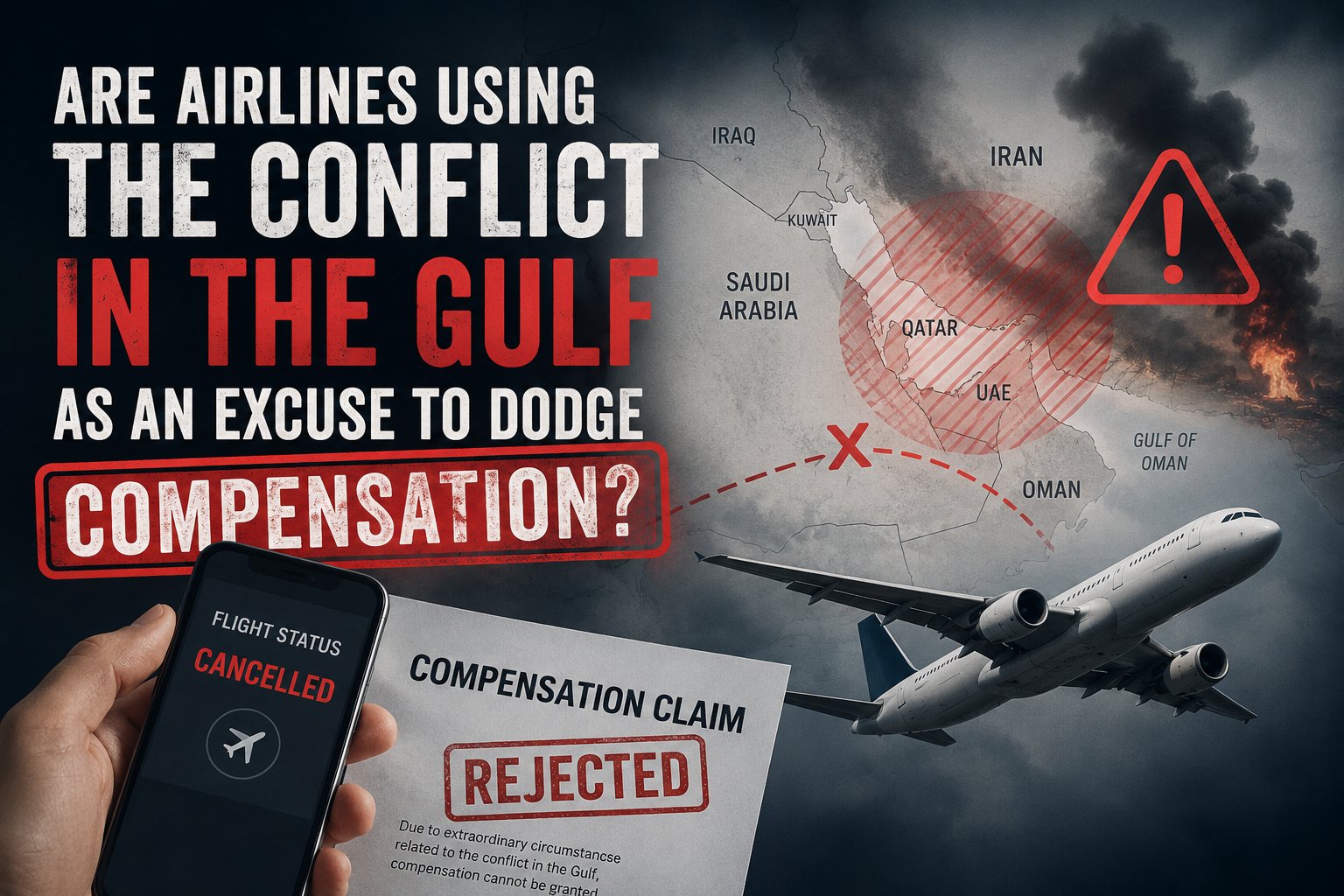
Gulf conflict and flight compensation
Are airlines using the Gulf conflict as an excuse to avoid legitimate compensation for passengers?
Extraordinary circumstances’ doesn't mean passengers have no rights at all; airlines still owe a duty of care.”
WOLVERHAMPTON, UNITED KINGDOM, July 24, 2026 /EINPresswire.com/ -- Renewed military conflict between the United States and Iran is now directly disrupting air travel thousands of miles away, forcing European airlines to reroute around the Persian Gulf and triggering cascading delays and cancellations at major UK and EU airports this summer.— Steve Reid
A ceasefire between the two countries, first announced in April 2026 and extended in June, has faced repeated violations in recent weeks — including reported strikes near the Strait of Hormuz and attacks on facilities in Kuwait, Qatar, and Bahrain. In response, EASA issued Conflict Zone Information Bulletin CZIB-2026-07 on 14 July 2026, advising all EU-regulated airlines to avoid the airspace of the UAE, Bahrain, Kuwait, and Qatar at every altitude, plus parts of the Gulf of Oman, until at least 29 July 2026. Kuwait's airspace remains fully closed to overflights — one of the clearest signs of how seriously regional authorities are treating the escalation.
From a Distant Conflict to European Departure Boards
For most passengers, the connection between a Gulf conflict and their own delayed flight out of Heathrow or Charles de Gaulle isn't obvious — but the two are directly linked. Europe's Gulf-Asia air corridors run through exactly the airspace now being avoided, forcing reroutes that add flight time, disrupt aircraft rotations, and create knock-on congestion at Europe's busiest hubs.
The scale has been significant. On 15 July 2026 alone, roughly 1,997 flights were delayed and 65 cancelled across nine countries, including England, France, Portugal, Italy, Spain, Germany, and the Netherlands. Paris Charles de Gaulle was hardest-hit, while easyJet accounted for close to a third of all cancellations that day. British Airways, Air France, and KLM also reported significant disruption, with delays rippling through Heathrow and Schiphol.
This was not an isolated day — similar four-figure delay counts were reported repeatedly through early July (1,840 on the 11th, 1,545 on the 13th) as airlines kept adjusting routes while the conflict showed no sign of fully resolving.
A Grey Area for Passenger Compensation
This kind of disruption raises a genuinely difficult question for affected passengers: does compensation apply when a flight is delayed or cancelled because of a security advisory, rather than weather, strikes, or an airline's own operational failure?
Under UK261 and EU261 rules, airlines are not required to pay financial compensation for delays or cancellations caused by "extraordinary circumstances" — a category that has traditionally included ATC restrictions, severe weather, and security threats. A government-issued airspace advisory tied to an active conflict would likely fall within that exemption in most cases, meaning affected passengers may not be entitled to standard compensation payouts.
However, passengers aren't left with nothing. Airlines remain legally obligated to provide care — meals, accommodation for overnight delays, and communication — and must offer rebooking or a full refund if a flight is cancelled outright.
"This is exactly the kind of disruption passengers find most frustrating, because the cause feels completely outside their control and outside the airline's control too," said Steve Reid, Marketing Director at Air Travel Claim. "But 'extraordinary circumstances' doesn't mean passengers have no rights at all — airlines still owe a duty of care, and it's worth checking the specifics of your own situation rather than assuming nothing can be done."
How to Tell a Legitimate Circumstance From an Excuse
Not every delay attributed to the Gulf situation will genuinely qualify for the extraordinary circumstances exemption — and the law puts the burden of proof on the airline, not the passenger. A few practical checks can help passengers work out which side of that line their own delay falls on:
● Check how directly your flight was affected. A flight actually rerouted around the Gulf, or operating an aircraft that was, has a stronger claim to genuine disruption than one delayed several days later at an unrelated airport with only a loose connection to the original cause.
● Ask the airline for the specific reason code, not just a general reference to "the security situation." Airlines are required to give a reason for cancellations, and a vague or unchanged explanation repeated across many days is worth challenging.
● Watch for the same excuse being recycled. If an airline cites the Gulf advisory for a delay a week or more after the original disruption, with no explanation of how the two are connected, that stretches the "direct causal link" courts require far thinner than case law generally allows.
● Ask what the airline actually did to manage the disruption — an aircraft swap, standby crew, faster rebooking. Simply absorbing the delay without any mitigation effort weakens an airline's case that it took "all reasonable measures," a requirement separate from the original cause being genuine.
What Affected Passengers Should Do
Passengers whose flights are delayed or cancelled due to Gulf airspace rerouting should:
● Keep all receipts for meals, accommodation, or transport incurred as a result of the disruption, as airlines are required to cover reasonable costs during a qualifying delay
● Request rebooking or a refund directly from the airline if a flight is cancelled, rather than assuming no options are available
● Check individual circumstances carefully, since compensation eligibility can depend on the specific cause recorded for each cancellation, and not every delay during this period will necessarily be attributed to the security advisory itself
About This Data
Figures are drawn from EASA's Conflict Zone Information Bulletin CZIB-2026-07 (published via easa.europa.eu) and disruption reporting aggregated from FlightAware-sourced coverage published 11–15 July 2026
Steve Reid
Air Travel Claim
+44 7912 021160
email us here
Visit us on social media:
LinkedIn
Instagram
Facebook
Legal Disclaimer:
EIN Presswire provides this news content "as is" without warranty of any kind. We do not accept any responsibility or liability for the accuracy, content, images, videos, licenses, completeness, legality, or reliability of the information contained in this article. If you have any complaints or copyright issues related to this article, kindly contact the author above.
